EU AI Act compliance
before the deadline
Article 50 transparency obligations and enforcement powers activate August 2, 2026; high-risk system obligations follow on December 2, 2027. Sentrik scans your AI code against 23 EU AI Act rules and generates the documentation evidence regulators require.
pip install sentrik && sentrik scan EU AI Act pack available on the Team tier — contact us.
The Timeline Changed in May 2026 — Here’s What Still Applies
Article 50 transparency obligations and national enforcement powers take effect
High-risk obligations for Annex III systems (deferred from 2026 by the May 2026 Digital Omnibus agreement; Annex I embedded systems follow Aug 2, 2028)
Colorado AI Act risk programs — mandatory since Jun 30, 2026
The May 7, 2026 omnibus agreement delayed high-risk obligations — it did not shrink them. Transparency, documentation, and human oversight requirements still arrive on fixed dates, and the evidence trail must cover your development history. Fines reach €35 million or 7% of global revenue for prohibited practices, and €15 million or 3% for high-risk obligations.
23 EU AI Act Rules. Mapped to Articles.
Sentrik checks both your code and your documentation against EU AI Act requirements.
Article 9 — Risk Management
Risk management system documentation, identification and analysis of known risks, mitigation measures, residual risk acceptance
Article 10 — Data Governance
Training dataset documentation, data collection processes, labeling operations, bias assessment, data gap analysis
Article 11 — Technical Documentation
System description, design specifications, development methodology, validation procedures
Article 13 — Transparency
User-facing documentation, capability limitations disclosure, intended purpose documentation
Article 14 — Human Oversight
Human-in-the-loop mechanisms, override capabilities, monitoring interfaces
Article 15 — Accuracy & Robustness
Performance metrics, bias testing, adversarial robustness, fallback mechanisms
Smart Scanning: Only Fires When Relevant
EU AI Act rules only activate when your project uses AI/ML libraries. No false positives on non-AI codebases.
Conditional Rules with applies_when
Sentrik detects whether your project imports AI libraries like PyTorch, TensorFlow, scikit-learn, Hugging Face Transformers, OpenAI, or Anthropic SDKs. EU AI Act documentation obligations only fire when these imports are detected.
No AI code? No EU AI Act findings. Sentrik doesn't waste your time with irrelevant rules.
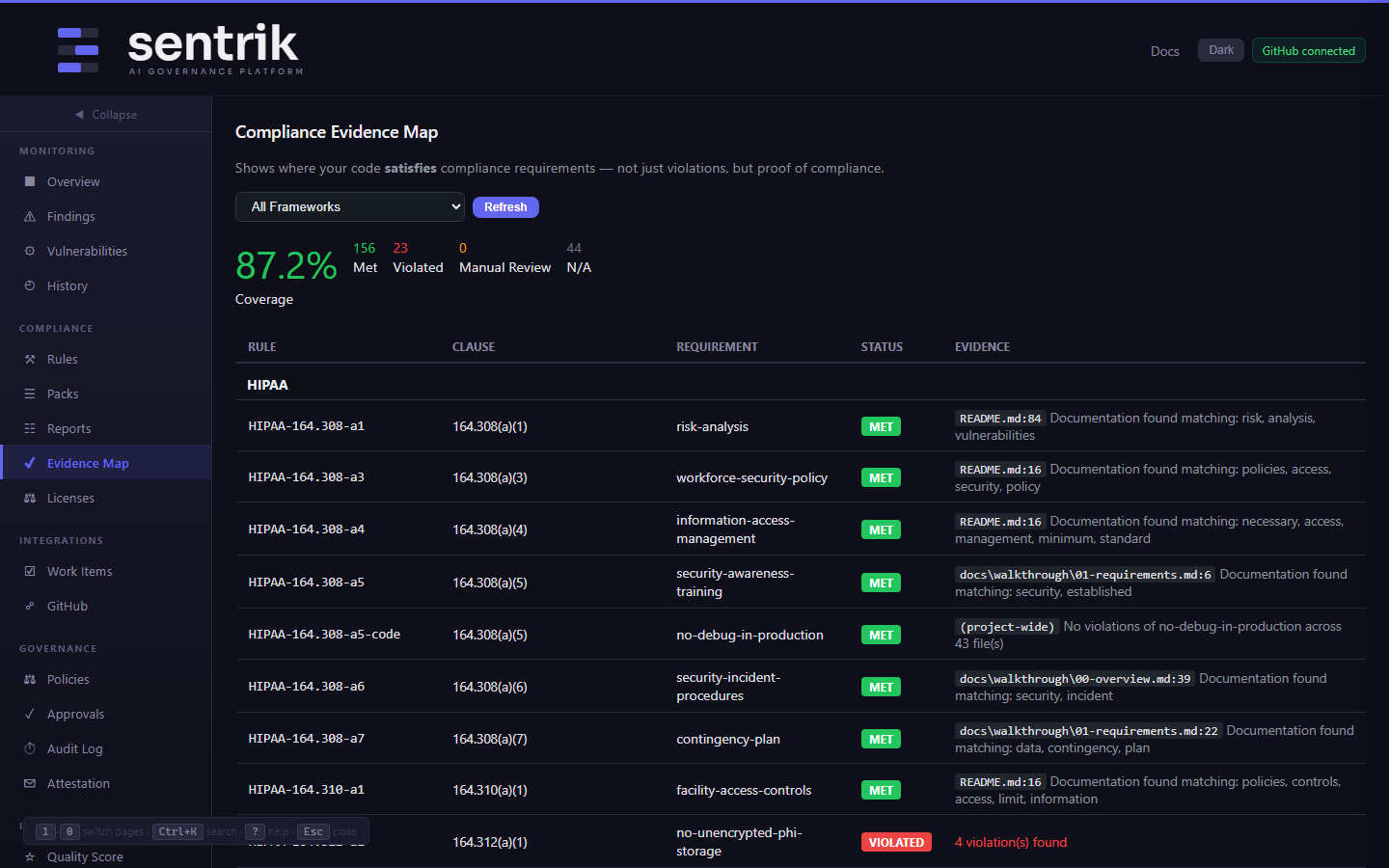
Documentation Evidence for Regulators
The Evidence Map proves your AI system meets each Article requirement.
Code-Level Evidence
Sentrik identifies where your code implements required controls: logging, human oversight hooks, bias checks, fallback mechanisms. Each maps to a specific Article.
Documentation Evidence
Searches your .md, .adoc, and .rst files for risk management documentation, data governance policies, and technical specifications required by Articles 9-11.
Signed Attestation
Cryptographically signed (HMAC-SHA256) compliance attestation proving your system state at a specific point in time. Tamper-evident and auditor-ready.
EU AI Act Compliance FAQ
Does the EU AI Act apply to my AI coding agent usage?
If you deploy AI systems classified as high-risk under Annex III (healthcare, critical infrastructure, employment, etc.), yes. The Act applies to deployers, not just providers. If your team uses AI coding agents to build software for these domains, the code must meet transparency and documentation requirements.
Didn’t the EU just delay the AI Act?
Partially. On May 7, 2026, the Council and Parliament agreed (as part of the Digital Omnibus) to defer high-risk obligations: stand-alone Annex III systems to December 2, 2027, and AI embedded in regulated products (Annex I) to August 2, 2028. The changes take legal effect once the Omnibus is published in the Official Journal, expected before August 2, 2026. What was not delayed: Article 50 transparency obligations, GPAI rules, the prohibited-practice bans, and enforcement powers — those still land August 2, 2026. The documentation and audit-trail work doesn’t shrink; it just has a firm later date.
What happens if I miss the deadlines?
Fines reach €35 million or 7% of annual global revenue for prohibited practices, and €15 million or 3% for non-compliance with high-risk obligations. Transparency violations carry penalties from August 2026; high-risk enforcement follows the deferred dates above. Regulators will expect evidence covering how the system was built — including the period before the deadline.
How does Sentrik handle the documentation requirements?
Sentrik's EU AI Act pack includes documentation obligations that check for the existence of risk management docs, data governance policies, and technical specifications. The Evidence Map searches your documentation files and links them to specific Article requirements. If documentation is missing, it flags it as a finding.
Can I use Sentrik with NIST AI RMF too?
Yes. Sentrik also has a NIST AI 600-1 Risk Management Framework pack with 16 rules. You can enable both EU AI Act and NIST AI RMF simultaneously for dual-framework coverage.
Start EU AI Act Compliance Now
Transparency rules land August 2026; high-risk evidence has to cover how you build between now and December 2027. 23 rules on the Team tier. Try the free tier first.
pip install sentrik && sentrik scan or